GRI Sustainability Report

What is a sustainability report?

A sustainability report prepared in accordance with GRI standards enables companies to demonstrate to all stakeholders how they manage their environmental impact. A sustainability report based on the GRI guidelines involves a materiality analysis, the preparation of the report, and finally a review aimed at improvement. 

Consequently, the aim of a sustainability report is to reflect the organisation’s economic, social and environmental performance, its past results and future objectives, and the strategies to be followed to achieve the latter.

The steps to follow to prepare a sustainability report in accordance with GRI standards include a materiality analysis, the preparation of the report and, finally, an improvement analysis.

Benefits of a GRI sustainability report

  • Reputation through the promotion of social responsibility. The sustainability report highlights the importance of corporate social responsibility in the organisation’s management.
  • Differentiation in a globalised market. The efficient use of resources and the ability to adapt to change are among the key benefits that CSR brings when it is integrated across all aspects of an organisation’s management. Complements your ISO certification.
  • A GRI sustainability report complements the ISO 26000 standard on Corporate Social Responsibility management. It can be integrated into an ISO 9001 quality certification, an ISO 14001 environmental management certification and an ISO 45001 occupational health and safety certification.
 

Steps for preparing the sustainability report

Materiality Analysis

The aim of the materiality analysis is to identify the relevant sustainability issues that the company must address in order to be sustainable in the long term.

  1. Identification of relevant issues based on their influence and importance in the decision-making processes of internal and external stakeholders.
    • Market research, consulting upcoming sustainability reports.
    • Development of surveys, meetings and other consultation tools for the various stakeholder groups.
  2. Prioritisation of the issues to be incorporated into the sustainability strategy.
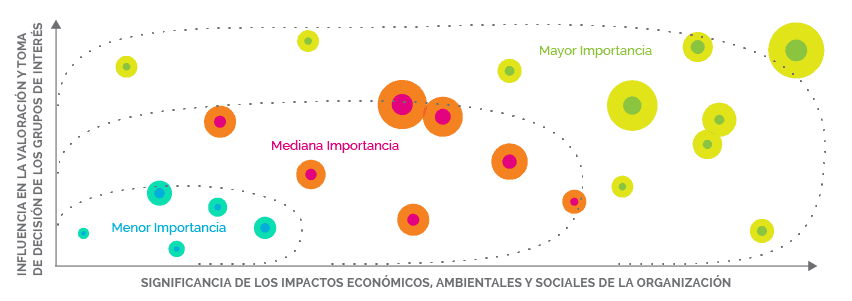
    • Analysis of the issues based on the significance of their economic, social and environmental impacts, and their influence on stakeholder decision-making.
    • Use of the Materiality Matrix for the analysis.
    • Selection of between 5 and 10 of the most relevant issues.Matriz de Materialidad GRI
  3. Validation of aspects: Identification of specific content to be included in the sustainability report, taking into account its scope, coverage and time frame.
  4. Assessment of indicators
    • Identify relevant economic, social and environmental indicators.
    • Analyse the results to identify areas for improvement.
    • Identify areas where stakeholder expectations are not being met and set performance targets.
Draft the report in accordance with the GRI Guidelines, reflecting the organisation’s economic, social and environmental performance, its past results and future objectives, and the strategies to be followed to achieve the latter.
  1. Verify the quality of the indicators based on the data collection methodology.
  2. Prepare the sustainability report in accordance with the GRI standards.
 

External verification of the GRI report serves to demonstrate quality and reliability to various stakeholders.

  1. Assistance with the certification application process.
  2. Support during the external audit.
  3. Support in addressing any non-conformities identified during the audit.

The aim of the layout and translation is to adapt the sustainability report so that it is understandable to stakeholders and highlights the progress made by the organisation.

  1. Translation of the document into two languages (Spanish, English, Catalan, etc.).
  2. Design the document in PDF format. A printed version is not normally planned.

Corporate Social Responsibility (CSR) consultancy

  • Preparation of your organisation’s GRI sustainability report. Please contact us for further information.
  • CSR consultancy to implement a Corporate Social Responsibility management system in accordance with Forética or IQNet SR10.
  • Internal or supplier CSR audits on Corporate Social Responsibility management and an action plan for improvement.
  • Strategic outsourcing to integrate Corporate Social Responsibility requirements into your ISO certification.
  • Corporate Social Responsibility training. Courses eligible for funding from the Tripartite Foundation

GRI reporting requirements

The identified stakeholders must be involved in defining the content of the sustainability report and its subsequent communication, with the report setting out how their reasonable expectations and interests have been addressed. Stakeholders include employees, shareholders, suppliers, vulnerable groups within local communities, civil society, etc.

The sustainability report must be based on the following principles: balanced, comparable, accurate, periodic, clear and reliable.

We highlight the following content that the GRI sustainability report must include:

  • Scope and coverage of the sustainability report.
  • Organisational profile. This should include the governance structure, commitments to external initiatives, strategy and analysis (in line with the strategy), and a description of the key impacts, risks and opportunities (for example, in accordance with ISO 31000) most relevant to the organisation arising from sustainability trends.
  • Stakeholder engagement in the consultation and communication processes during the period covered by the report. This information is not limited to the inclusion of stakeholders in the preparation of the sustainability report.
  • Impact of sustainability trends, risks and opportunities, including the prioritisation of key sustainability aspects, such as risks and opportunities, according to their significance for the organisation’s strategy. This should include objectives and a description of the governance mechanisms put in place to manage the risks and opportunities associated with the identified risks and opportunities.
  • Performance results and analysis, using indicators of the organisation’s performance in the economic, environmental and social spheres (including labour aspects, human rights, society and product responsibility).